
From DNA to Survival: How Genomics Is Revolutionizing Conservation
On the vast plains of the western Serengeti, millions of wildebeest surge across the grasslands. Elephants follow ancient migration routes etched into deep memory, while lions scan the horizon with quiet precision. It is one of the worlds most iconic ecosystems– defined by movement, resilience and survival.
Yet beneath this visible spectacle lies another story. One that is less visible, more precise. And increasingly, more important.
It is written in DNA.
In every strand of hair, every drop of blood, and every footprint pressed into the dust, genetic material holds a hidden record of survival, adaptation, and risk. For a new generation of Tanzanian scientists, the ability to interpret that record is emerging as one of conservation’s most powerful tools.
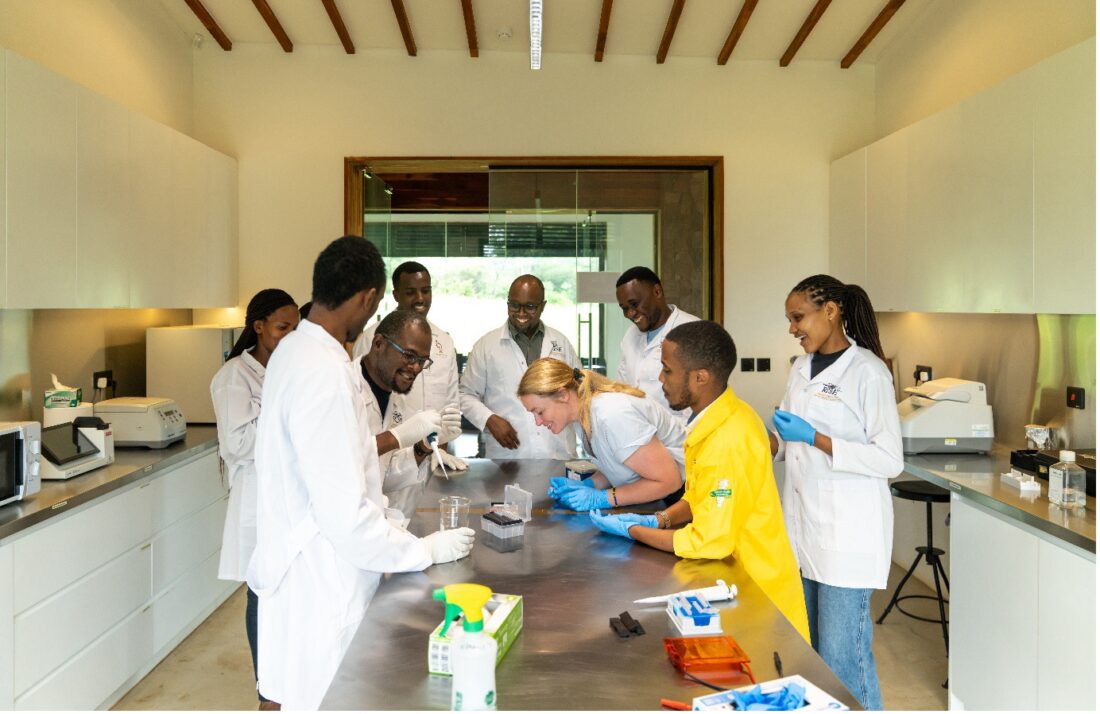
At the Grumeti Fund’s Research and Innovation for the Serengeti Ecosystem (RISE) facility, scientists, students, and conservation professionals recently gathered for intensive training in conservation genomics. Delivered in collaboration with the Nelson Mandela African Institution of Science and Technology and the University of Dar es Salaam, the program focused on practical skills – from DNA extraction and population genetics to bioinformatics and wildlife forensics.
Yet the purpose extends far beyond technical capacity. It is about reshaping the way conservation is understood and practiced.
Across Africa, wildlife faces immense pressure from poaching, illegal wildlife trade, and habitat fragmentation. Some of these threats are visible on the ground, while others remain far more difficult to detect. A population may appear stable, even abundant; while quietly losing the genetic diversity it needs to adapt to disease, climate change, or environmental stress.
Genomics is helping to change that.
Through DNA analysis, scientists can identify early signs of inbreeding, assess the genetic health of populations and trace the origin of confiscated wildlife products such as ivory or bushmeat. What was once hidden within population can now be measured and acted upon.
For participants this shift is immediate and tangible. The training transforms abstract science into practical application: the ability to take a biological sample and turn it into evidence. Evidence that can guide conservation decisions, strengthen law enforcement, and support efforts to disrupt illegal wildlife trade networks.
That capacity is urgently needed. Demand for the workshop far exceeded expectations, with 169 applicants competing for just 21 places from 14 institutions. This reflects a growing recognition that the future of conservation will depend not only on protecting landscapes, but on understanding whether those species are strong enough to survive in the future.
 It also signals a broader shift in leadership.
After nearly a decade of advanced training in the United States, RISE Head Scientist Dr. George Lohay returned to Tanzania with a clear mission: to build local expertise in conservation genomics. That vision is now beginning to take shape. The recent registration of the RISE Research and Diagnostics Laboratory under the Veterinary Council of Tanzania marks an important step toward establishing long-term national capacity in wildlife genetics.
For emerging scientists like Edson Kimario, the implications are clear. By building genetic databases for endangered species, researchers can trace seized wildlife products back to specific populations, providing evidence that is far more difficult for traffickers to dispute or evade. However, scientific progress alone is not enough. Bridging the gap between research and policy, he notes, will be critical if these tools are to drive real-world change.
Others see the impact stretching far into the future. For Faith Jekemei, a master’s student in molecular biodiversity, genetics offers a way to protect not only individual species, but the integrity of entire ecosystems. By identifying vulnerabilities early, conservation strategies can become more precise, proactive and effective.
This integration of molecular science into conservation marks a clear turning point. For decades, efforts to protect wildlife focused largely on visible threats such as habitat loss, poaching, and human-wildlife conflict. Today, the field is expanding to include risks that are invisible to the eye – but may ultimately determine species survival.

Dr. Ronald Mellya sharing insights with attendees during the workshop.
Research is already revealing what is at stake. Dr. Ronald Mellya, a senior conservation officer with the Tanzanian National Parks and a specialist in black rhino genetics, has shown that allowing natural movement across the unfenced Serengeti-Mara ecosystem helps maintain genetic diversity in eastern black rhino populations. His work indicates that natural dispersal can reduce the risks of inbreeding more effectively than some earlier management strategies. The lesson is clear: protecting wildlife requires not only safeguarding animals but also maintaining the ecological connections that sustain them.
The Serengeti will always be defined by its visible wonders – the great migration, the predator-prey balance, and the vast openness of its plains. But it is also becoming a place of invisible discovery.
Here, the future of wildlife is written in genetic code – patterns too small to see, yet powerful enough to shape conservation in profound ways.
And for the first time, a new generation of African scientists is leading the effort to read that code, apply its insights, and help define what comes next.